


Your cart is currently empty!
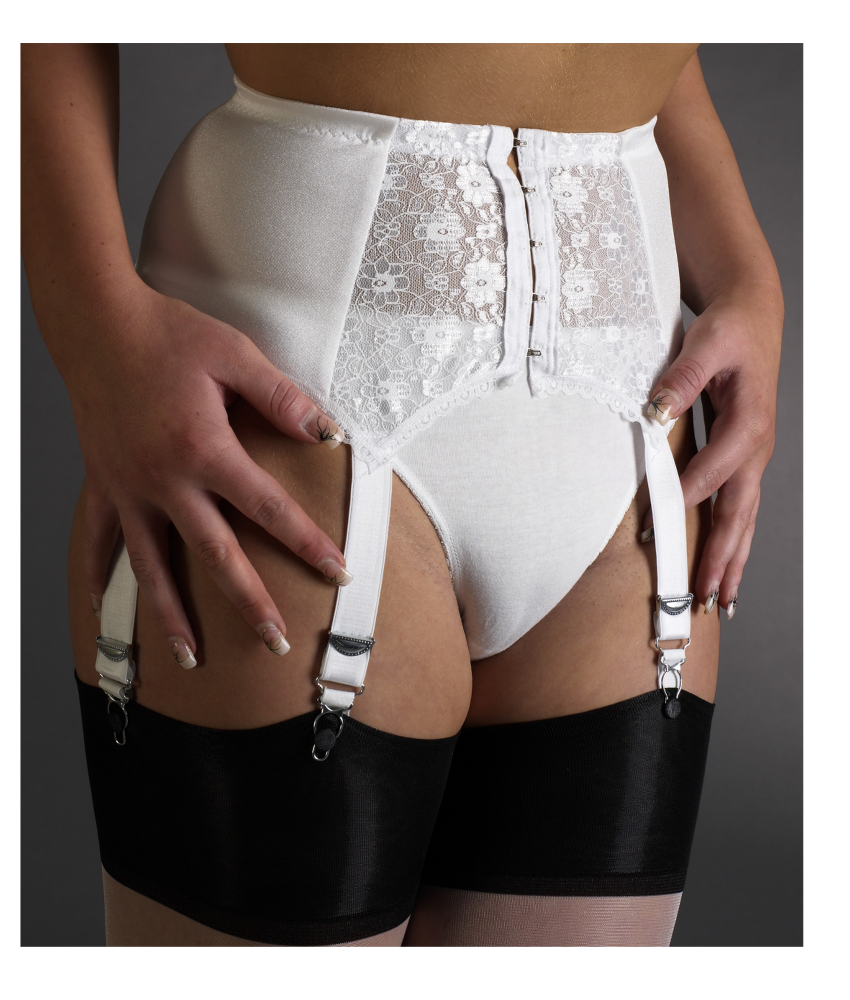
All about Lace – whether for Dresses, Tablecloths, or Suspender Belts
Hello everyone,
I’m delighted to have such a wonderful topic for you again today. After last time’s wedding blog, today we’re talking about lace! Of course, a wedding dress is a prime example, but there are also many other beautiful dresses, tops, accessories, and especially lingerie featuring lace. It’s definitely modern, no matter how it’s used.
Lace Suspender Belts from Vicky’s Nylons
At Vicky’s Nylons, we offer several products featuring lace, from the delicate Lingadore suspender belt or the fantastic Burlesque range by Elaine Edwards, to this lovely “Rom” series in black, white, and red.
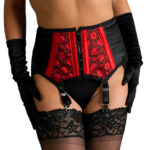

Even the “Crossover” suspender belt by Elaine Edwards in black and white clearly demonstrates the sexy effect of lace on lingerie.
But let’s start at the very beginning: What is lace? Where does lace come from? How is it made? What types are there?
What is Lace?

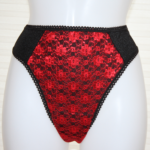
Lace is a textile made from yarn, consisting of patterns, ornaments, and open spaces, designed to allow the skin or underlying material to “shimmer through”. Lace can also refer to flat structures with jagged edges. On the left, you can see a piece of lace with floral patterns and a red background. The open spaces are very large in this instance. Lace often serves as decoration rather than an actual garment, with exceptions like lace dresses and, of course, lace doilies.
The History of Lace
Lace was invented in Italy during the Renaissance (15th/16th century) and elevated to an art form. Needle lace developed from cutwork embroidery and quickly spread to France and Spain. In Spain, gold and silver threads were increasingly used to create lace, and the craftsmanship and expensive materials soon made lace an item reflecting wealth. From the 18th century onwards, lace was produced in Brussels and Bruges, which remain centers for high-quality lace work today. The city of Tulle in France was and still is particularly known for the bobbin lace fabric “Tulle” named after it. In Germany, Barbara Uttmann is considered the pioneer of lace, who introduced bobbin lacemaking in the Ore Mountains around 1561 and founded a company that produced lace fabric.
By the 19th century at the latest, lace was a luxury item because the effort involved was very high and the materials very expensive.
Since the 19th century, machines for its production were invented and continuously developed, so that today, anyone can afford lace in all shapes and colors made from synthetic fibers. However, when it comes to quality, material, and craftsmanship, the sky’s the limit for lace prices.
In 2010, Alençon needle lace was even elevated to World Heritage status.
By the Way, Vicky’s Nylons’ “Secret” Family Has Welcomed a New Addition, the New


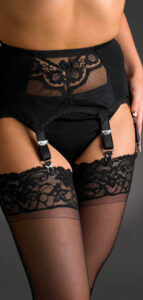
After “Secret View” and “Secret Affair”, we are proud to introduce the “Secret Temptation” lace suspender belt. Except for a small power mesh square at the front, it is made of lace with a floral pattern. It also features a 3×3 hook-and-eye closure at the back and six elegant, smooth garters with metal clips. It’s also the reason I decided to write to you about lace today!
What do you actually think of the nylons with lace, as shown in the pictures on the left and right? I think they’re really pretty; Vicky’s Nylons should consider offering them, don’t you think?
And for those who haven’t had enough, I’ve also briefly summarized the most important types of lace below. To everyone else, I wish you a continued beautiful and especially sunny June, and I look forward to your comments, feedback, and the next blog post!
See you soon
Yours, Julia
Some of the many Different Types of Lace
Lace is categorized into genuine and imitation types. Genuine lace is always handmade. However, today there is machine-made lace of the highest quality that looks really good. Many even find machine-made lace superior, as it achieves a uniformity that cannot be mastered by hand. These machine-made laces are called Raschel lace and have a market share of about 75%. They began to be produced at the beginning of the 19th century on a warp knitting machine, which was later called a Raschel machine. Today, these machines have been further developed and produce lace in all colors, patterns, and various materials. But back to the different types of lace. Broadly speaking, a distinction is made between knotted lace, needle lace, and bobbin lace. Below, I’ll give you a rough overview with brief explanations and examples.
Macramé or Knotted Lace
Knotting technique of Arabic origin, where individual threads are worked into different knots, and fringes form the finish. Variations are also created through different materials and colors. Examples:
- Filet Lace:
- for linen or cotton doilies, knotted lace
Needle Lace or Sewn Lace
is a standalone piece of lace sewn into space with a single needle and only one thread, without a foundation. Sometimes a strip of canvas or oilcloth is used as a foundation. Loops or buttonhole stitches are used. Examples:.
- Oriental Needle Laces:
- worked from a fabric edge into open space
- Turkish, Armenian, and Palestinian Lace
- European Lace:
- Originating in Italy, first a drawing is created, then a contour thread is sewn onto it and filled and bordered with loops, darning, or spiders. Finally, the foundation is removed.
- Sol Lace
- Appliqué Lace with sewn motifs and the
- Tape Lace
- Tulle Lace
Bobbin Lace
Pattern created by crossing and twisting pairs of threads, where individual strands are held in shape by pins until completion. Variation is achieved by adding extra threads. Often wool, cotton, and even silver or gold are used. Bobbin lace is often used for inserts or borders. Examples:
- Braided Lace or Trim Lace:
- geometrically arranged, round or pointed ends
- tapering in a star shape
- Honiton:
- English, fine bobbin lace, high-quality and usually with patterns of: thistle, fern, clover, rose, or passionflower
- named after Honiton (a town in Devon).
- Milanese, Brussels, and Plauen Lace:
- Bobbin lace from Milan and Brussels, tulle lace, and later chemical lace from Plauen
- Guipure:
- Term for gimp cord, very valuable bobbin lace made from gimp
- no longer a specific term today
- Tatting:
- also called shuttle lace, is a knotted lace that contains rings and arches
- also known in Egypt and China
- similar to crochet
- Chantilly, Bobbin-fining, Valenciennes, or Centre-gimp:
- Laces produced on a Bobbinet machine, invented in the early 19th century, similar to bobbin lace, made from gimp threads, hardly known anymore
- Chantilly: French floral, black bobbin lace, made of silk on a net ground